- InvestiBrew
- Posts
- 🗞 Wasabi & Leverage
🗞 Wasabi & Leverage
Retail traders just found out what a carry trade is, I am here to walk you through exactly what USDJPY means for markets.

Offside Capital
January 28, 2026

In partnership with

WHILE YOU POUR THE JOE… ☕️

$DXY Dollar Index, Thinkorswim
The dollar is now at the lowest level since August 2025… 📉
Traders are scared away as speculation over whether the United States will sacrifice its own currency to save the Japanese Yen, especially as trillions are riding behind the carry trade.
Now it wasn’t until last year that retail traders found out what a carry trade even is, but that’s not the point.
The point is that there is no such thing as saving the Yen by selling dollars, no matter how anyone on the internet tries to make sense of it.
Fundamental rules of currency markets don’t apply to the Yen, and I will explain it all to you in a second.
Most importantly, what you can do about it in your stock portfolio, but only Deal Room members will get that signal in the coming days.
So make sure you grab a 7 Day Free Trial and get caught up there.
Speaking of the Yen, let’s get on with today’s email 📧…
AI in HR? It’s happening now.

Deel's free 2026 trends report cuts through all the hype and lays out what HR teams can really expect in 2026. You’ll learn about the shifts happening now, the skill gaps you can't ignore, and resilience strategies that aren't just buzzwords. Plus you’ll get a practical toolkit that helps you implement it all without another costly and time-consuming transformation project.
A TRADER’S PARADISE
Priced In?
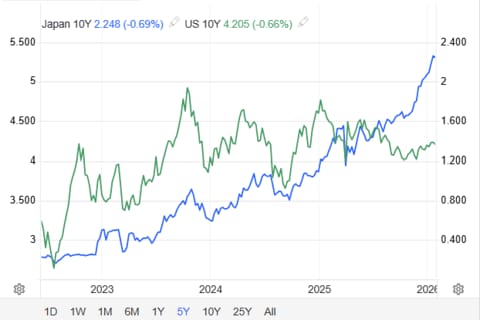
Japanese 10Y Yields vs U.S. 10Y Yields, Tradingeconomics
The fact of the matter is, liquidity is king.
As the liquidity cycle in the United States bottomed in 2022, the Fed began cutting rates and introducing more money into the system.
So, inflation expectations, and risk-on rotations started to take place. Hence, bonds sold off sending yields much higher.
However, in 2025, Japanese yields just kept on going as the country’s inflation rate swung to new highs.
Fundamentally, there are only three things you should worry about:
Liquidity
Volatility
Relative value/risk
Liquidity expansion typically hurts currencies, and that’s exactly what you saw in the 2022-2025 period, nothing new there.
Traders around the globe though, they started to position as soon as they saw the writing on the wall.
A writing that went something like this:
A weaker Yen is bullish for stocks overall, but especially so for services and multi-national names in Japan
Which is why stocks like Nomura (NMR) and Mitsubishi UFJ Financial (MUFG) rocketed like they were some meme coin.

Nomura Stock, Thinkorswim
On the other hand, you’ve had domestic consumption names like Sony (SONY) come off into bear market territory.
So the weaker Yen was priced in way before this whole drama even took place.
Now it’s time for these bond traders to get rewarded, and that’s where inflation comes into play.

Japanese Inflation, Tradingeconomics
From 2022 to 2025, Japan’s inflation rate went from negative to a high of 4.3%.
It is now crashing down to 2.1%, the lowest in a three-year period. Fundamentally, this should be bullish for the Yen as its depreciation slows down.
But here is what matters most for the potential rebound in the currency, and the so-called issues with the carry trade.
Japan’s yield curve (10y minus 2y) began expanding in 2023, which explains why the Yen crashed so hard since. Now here’s the bottom line, if there was ever going to be a massive carry trade unwind, it would have already started in 2023 when the curve steepened.
Not now, which goes back to the saying of “if it’s in the news then it’s already too late.”

Japanese Yield Curve
Liquidity wise, Japan is starting to enter a severe tightening cycle, and that’s fundamentally bullish for the Yen in the coming quarters.
Now,
Is the U.S. going to “save” the Yen? Unlikely, I think traders are already doing that.
I call the Yen a trader’s paradise, because its price action is massively correlated to its underlying volatility regimes.
Let me explain:

USDJPY Volatility Regimes, InvestiBrew
During 2021-2023, volatility regimes peaked as the pair traded higher and higher.
Then, as volatility trended lower into the end of 2024, Yen futures spiked massively as a reaction, sending the USDJPY lower.
We can see the same thing happening now in mid-2025 to the present, as volatility continued to contract and the Yen’s price crashed down to late 2023 levels.
However,
Volatility is coming back to the pair, and Yen futures are back to making a breakout.
In other words, traders hunting for volatiltiy are saving the Yen, not the U.S. government.

/6J Yen Futures, Thinkorswim
That gray-shaded area is what’s known as a low-volume node based on the market profile (turquoise in the background).
It’s exactly where markets want to send the Yen before testing any real interest of a breakout, and if this volatility view is correct at its core, then I believe that’s exactly what will end up happening.
Again,
Traders will take care of this, not government intervention, as long as volatility is there for them.
What’s the trade?
If you see the Yen break past these levels, and the Yield curve start to come down there, then I would buy domestic consumption (SONY) along with services names in Japan.
Also, I would look to short net exporters like Toyota (TM) though this could be offset with some of the tariff deals happening now.
Where is the Dollar headed?
Everyone is watching the fall (and fall) of the dollar, wondering what they should do about it right now.
I will cover this in a later issue, probably this week.
For now, I can leave you with this:

$DXY Regression Factors, InvestiBrew
The Dollar’s returns can be explained by two fundamental factors (both of which are about to make a major move):
Rate duration (TLT vs SHY)
Volatility (VIX)
We have seen a drawdown in the S&P 500’s volatilty regime, making the dollar not that attractive as a hedge.
Then again, we’ve had a real rate environment hovering around 1.5%, weakening the dollar fundamentally.
My assumption for being bullish DXY here is that rates will either hike or remain where they are while inflation comes down significantly (expanding real rates).
This also helps my case for IVE/IVW covered in this newsletter, all pointing to a stronger dollar.
That’s a story for my next post, catch you there.
Psst.. Don’t forget to join my Deal Room 7 Days Free, whatever the dollar does will probably have dozens of equity implications and trade ideas for you to take.
To your success,
G 🫰